TOTALLED (2004)
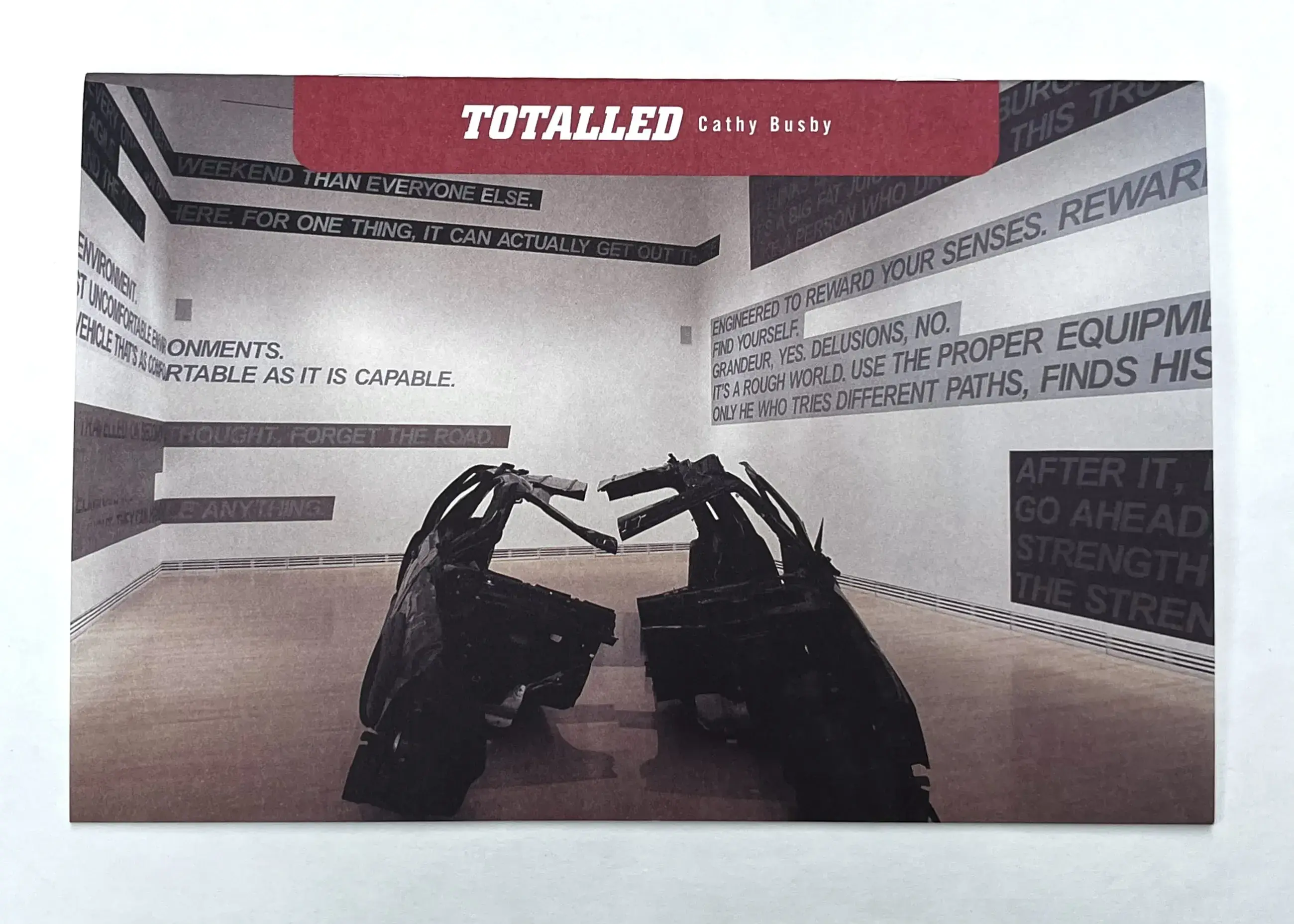
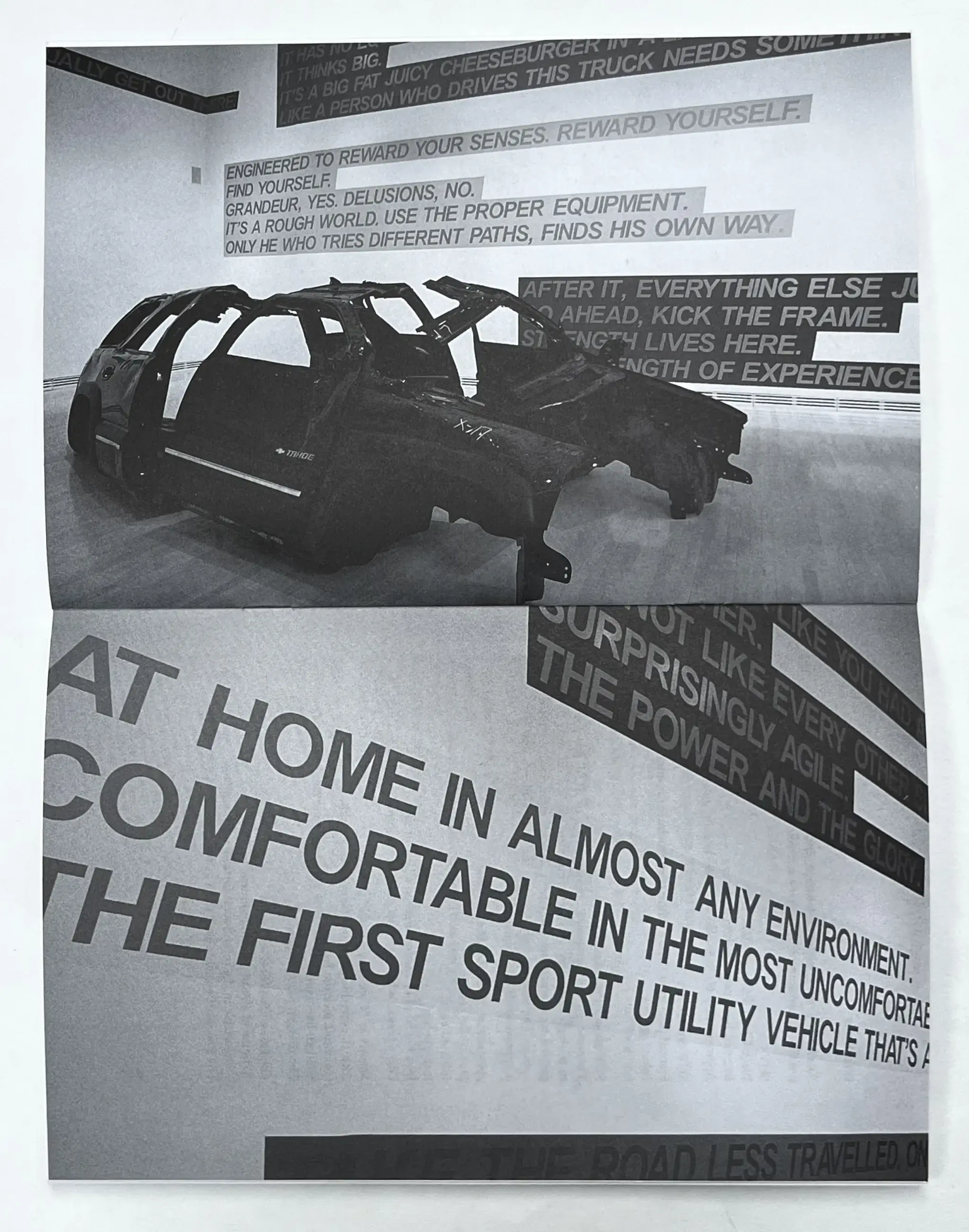
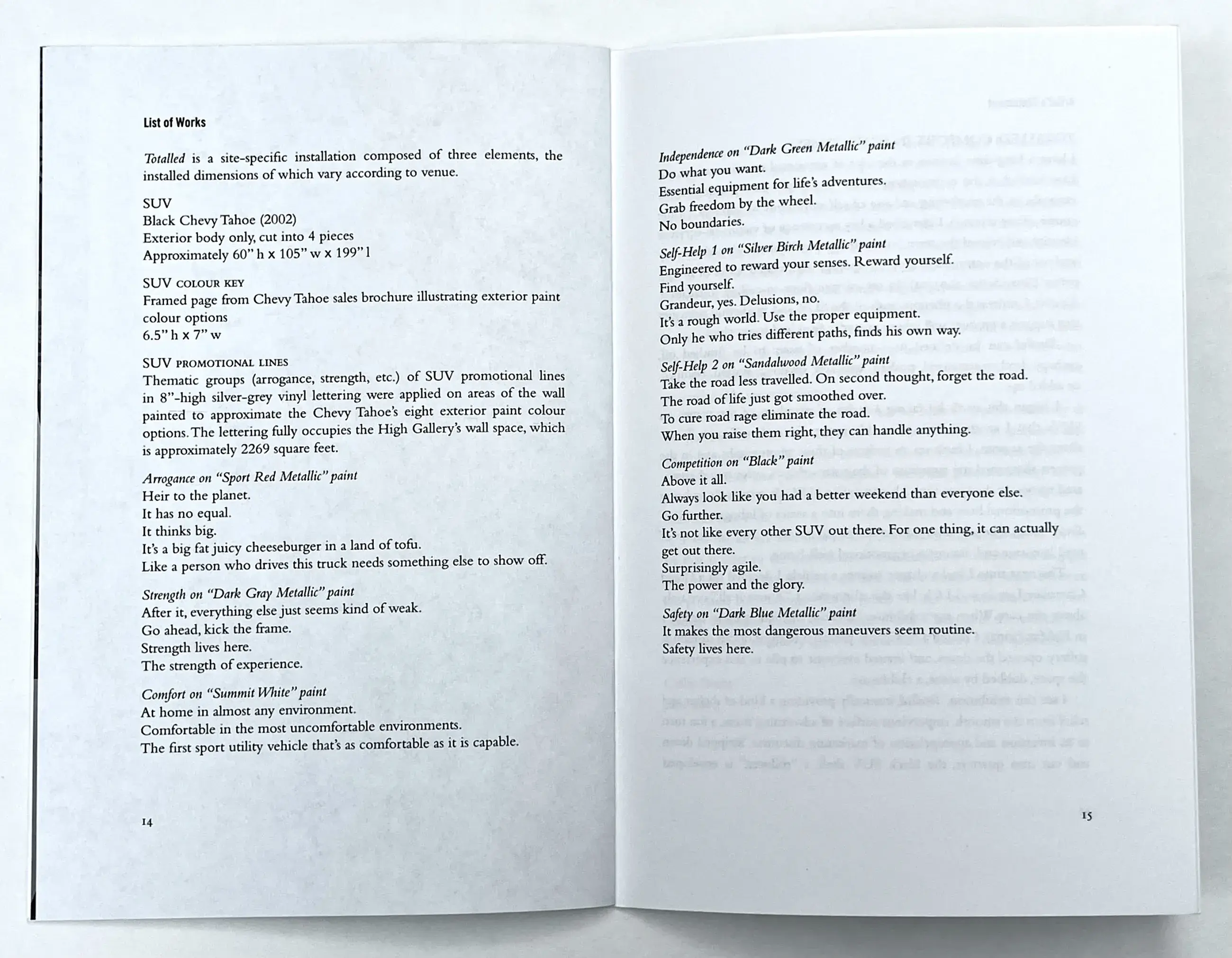
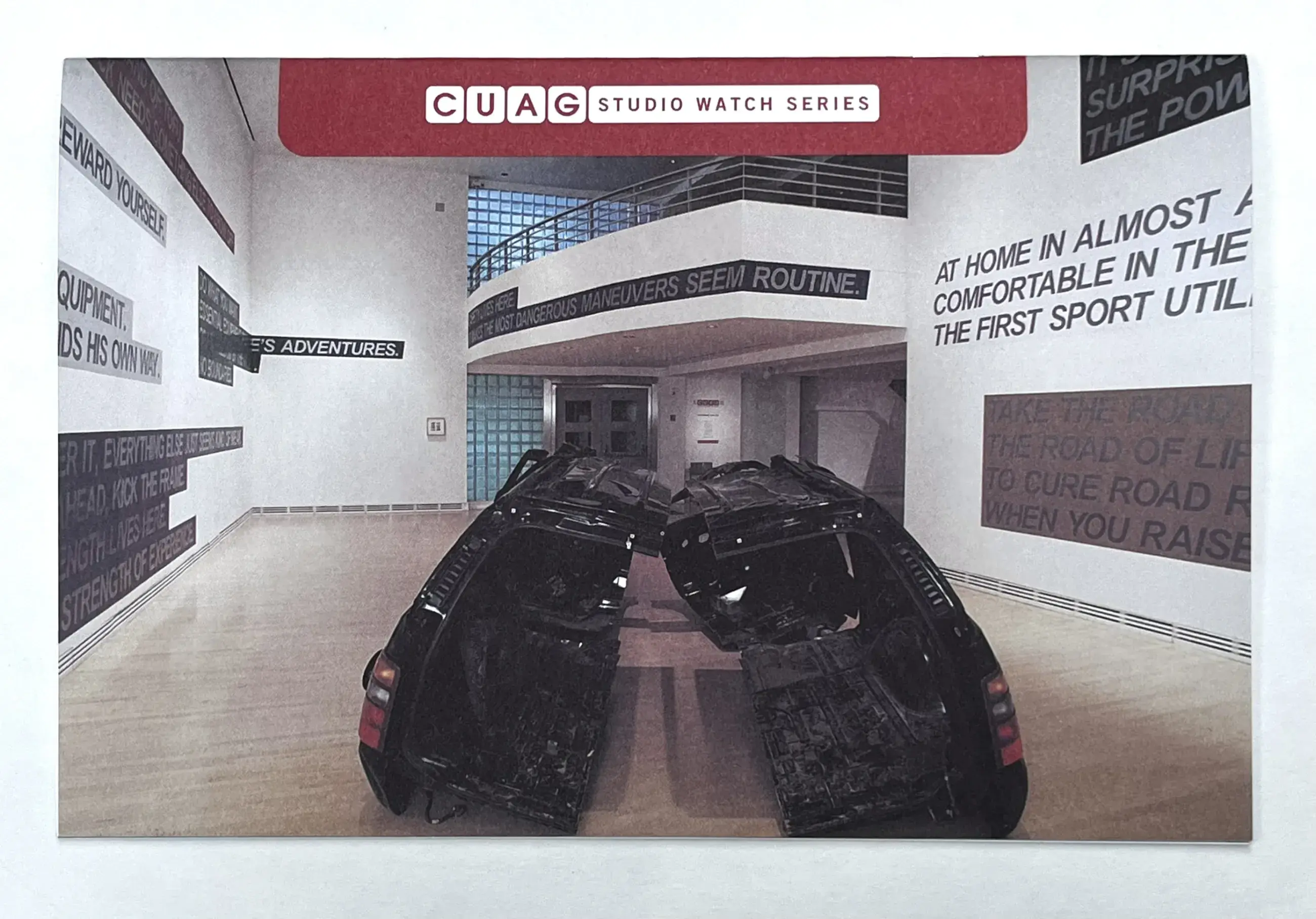
This 20-page in house publication accompanied my 2004 installation Totalled exhibited as part of Carleton University Art Gallery’s (CUAG) Studio Watch Series, curated by Sandra Dyck. Containing the artist statement below, as well as an essay Jan Budney, this publication provided a legend for the installation. The colours that I used to highlight the promotional SUV taglines I collected were all the colours that the Chevy Taho, which was splayed in the centre of the gallery, came in. Each slogan was categorized and arranged: Arrogance on “Sport Red Metallic”; Strength on “Dark Gray Metallic”; Comfort on “Summit White”; Independence on “Dark Green Metallic”; Self-help 1 on “Silver Birch Metallic”; Self-help 2 on “Sandalwood Metallic”; Competition on “Black”; Safety on “Dark Blue Metallic”. This publication acted as a kind of critical-poetic legend to the installation.
TOTALLED: COMFORT IN SCARY TIMES
I have a long-time interest in the idea of emotional transformation, and have looked at the construction of the recovery industry as found, for example, in the marketing and use of self-improvement manuals. In the course of my research, I identified a key recurrence of victim-to-survivor identity and coined the term "autopathography." This developed into my analysis of the commodified public apology and related series of ink-jet prints (Sorry Series, 2002-04). In my current floor-to-ceiling installation, Totalled, I address the phenomenon of the SUV and marketing strategies that suggest a product will relieve everyday fears and insecurities.
Totalled can be defined in a number of ways: to be finished off, perhaps dead, traumatized, trashed, wrecked, smashed, wasted, bombed, or added up.
I began this work by taking a series of snapshots of the names on SUVs that I spotted: Expedition, Navigator, Excursion, Escape, Tahoe. Over the seasons, I built up an archive of these photographs and in the process sharpened my awareness of their sizes, shapes, colours and associated names. At the same time I began saving SUV ads, eventually isolating the promotional lines and making them into a series of lithographs ( SUV Series, 2002). The ads annoyed and fascinated me with their conflation of road language and discourse of emotional well-being.
The next time I had a chance to rent a vehicle I decided on a Grand Cherokee Laredo and I felt, like the ad promised, "Above it all," certainly above the cars. When my exhibition, Testdrive, opened at eyelevelgallery in Halifax (2002), I rented a Navigator, parked it in front of this storefront gallery, opened the doors, and invited everyone to pile in and experience the space, dubbed by some, a clubhouse.
I see this exhibition, Totalled, ironically providing a kind of shelter and relief from the smooth, impervious surface of advertising noise, a fun turn in its inversion and appropriation of marketing discourse. Stripped down and cut into quarters, the black SUV shell, a "rollover," is enveloped by groupings of text on the surrounding walls, arranged to elaborate a message of self-improvement, competition, strength, etc. The wall text fills this particularly tall gallery space, using it like a container. Totalled inflates the words for SUV advertisements and deflates the vehicle itself.
The discourse of survival and emotional struggle, of relief from our worries and hankerings, has been a preoccupation of mine for some time, and SUV advertising is just one instance of its use. We are surrounded by this discourse, not just in the marketing of products and services, but in political speeches and workplace dynamics. Though on many levels we live in a regressive time of "every man for himself," this is often filtered through an emotional rags-to-riches narrative: "Only he who tries different paths, finds his own way" or "Comfortable in the most uncomfortable environments."
How do we manoeuvre and how are we manoeuvred emotionally at this juncture in consumer culture, then? This is the same question that became important in the midst of my work on recovery culture generally, self-help books and public apologies. I want the presence of my art to point to new critical possibilities and I hope that the parts add up to more than one new total.
I am for an art that knows its predecessors and inspirations, for an art that is alert to the conditions of contemporary culture and engages with them. In contemporary art discourse I situate my work between the political bite-through-text of Jenny Holzer and Martha Rosler, the cutting-into-built-things of Gordon Matta-Clark, and the critical and full occupation of gallery space in the work of Garry Neill Kennedy.
Cathy Busby
June 2004